A convertible loan is a quick way to raise money before you do a full funding round. You don’t have to agree on what your company is worth yet: the next round settles that. That is exactly why the key terms come down to a handful of numbers. Here’s what they are and what they mean in practice.
What is a convertible loan?
An investor lends money to your BV. You don’t pay it back; instead, at the next funding round the loan, plus the interest it has built up, turns into shares. The investor gets those shares at a better price than the new investors, as a reward for coming in early.
It’s a popular choice for a first round with angels, or to bridge the gap between two rounds. The agreement is shorter than a full investment agreement, and in the Netherlands you only need a notary once the loan converts.
Which terms do you agree?
- Principal: the amount the investor lends.
- Interest: often a few percent a year. It is usually not paid out but added to the amount that converts.
- Discount: the reduction on the share price of the next round, often between 10% and 25%.
- Cap: the maximum valuation at which the loan converts. If the round comes in higher, the investor uses the cap instead.
- Qualifying round: the minimum size of a new round that triggers conversion, so a small interim round doesn’t convert the loan by accident.
- Term: what happens if no round comes within, say, two years. Repay, convert at the cap, or extend.
- Sale of the company: what the investor receives if the company is sold before the loan converts.
- Subordination: whether the loan ranks behind other creditors. Banks often ask for this before they lend themselves.
How does conversion work? A worked example
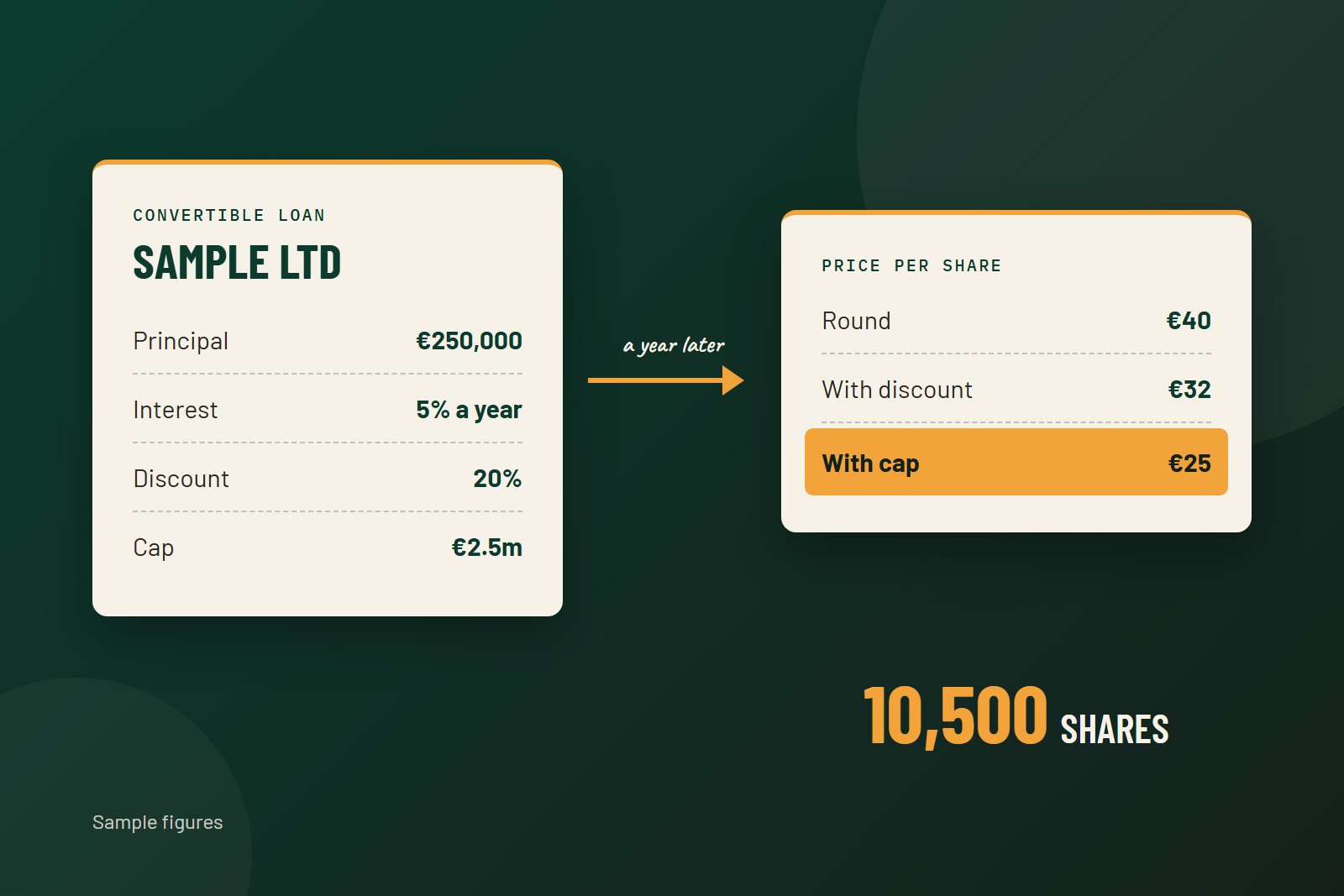
Sample Ltd has 100,000 shares. An angel lends €250,000 at 5% interest, with a 20% discount and a €2.5 million cap. A year later there’s a round at a pre-money valuation of €4 million.
| Price per share | |
|---|---|
| New investors (€4m / 100,000) | €40 |
| With a 20% discount | €32 |
| With the cap (€2.5m / 100,000) | €25 |
The investor gets the lowest price: €25. With a year’s interest the loan is worth €262,500, so that’s 10,500 shares. Without the cap it would have been just over 8,200. The higher the next round, the more the cap matters, so work out beforehand what the loan does to your stake at different valuations.
What does it mean for your books?
Until it converts, the loan is a liability on your balance sheet. You book the interest as a cost every year, even if you don’t pay it out; it is added to the debt. On conversion the debt disappears and the amount moves into equity: the nominal value of the shares as share capital, the rest as share premium.
If the lender is already a shareholder, the interest has to be at arm’s length: what an independent lender would charge. If in doubt, have the tax side checked.
What happens at the notary?
The loan agreement itself is a private agreement. Issuing the shares on conversion, however, requires a notarial deed. Check your articles of association and shareholders’ agreement in advance too: existing shareholders often have a pre-emptive right to new shares. Agree that they waive it for this conversion, so it doesn’t hold up the round.
Want some help?
We can draft a straightforward convertible loan with you for one or a few investors, with a model showing what it does to your stake at different valuations. For a round with many parties or unusual terms, bring in a lawyer. After conversion we process the loan and the new shares in your books, and keep your investors up to date with a regular monthly report.
Sources
- NOM, eBook Converteerbare lening (Dutch)
- Stripe, Convertible notes vs. SAFEs
— Boele