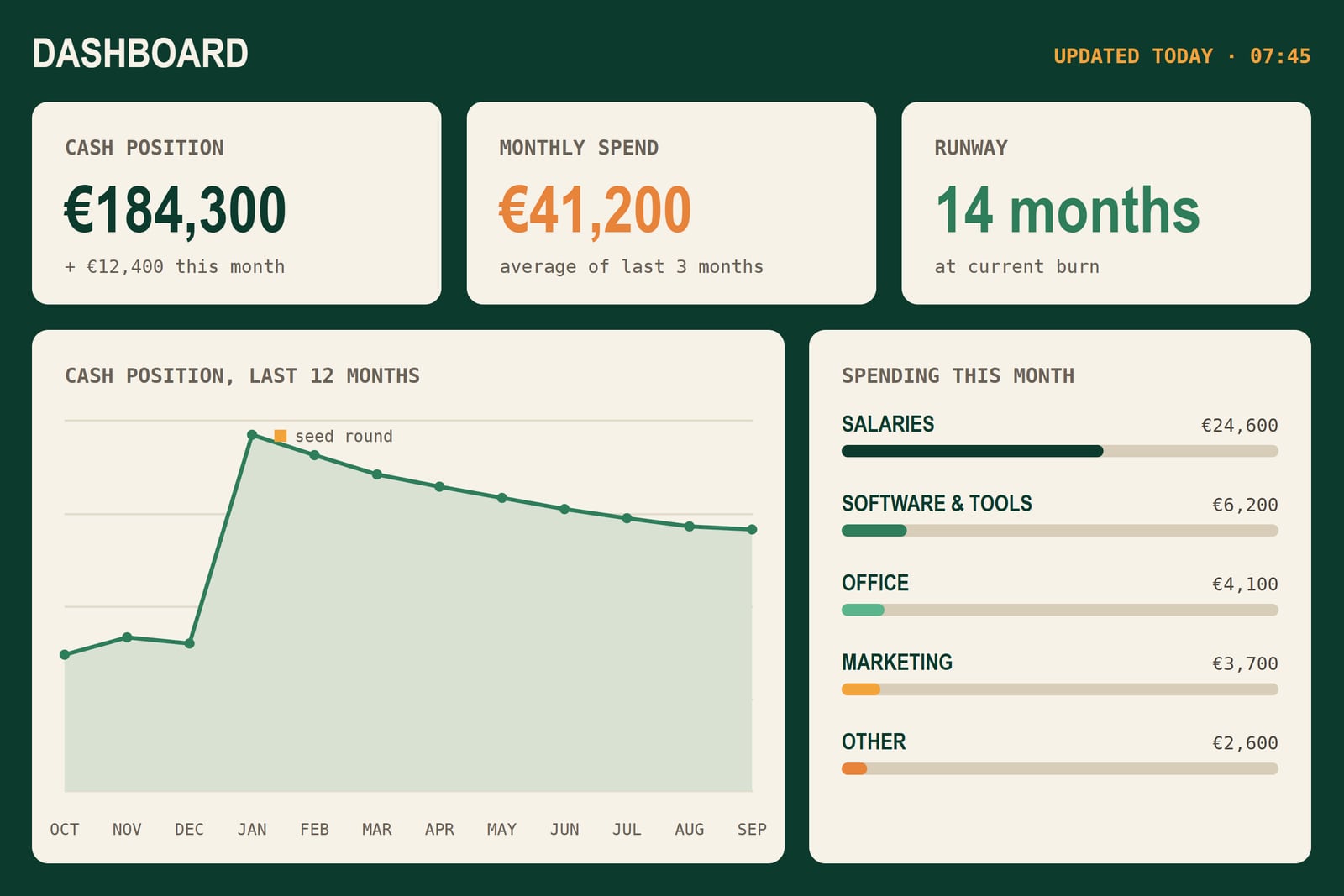
Runway is the number of months your company can keep running on the money it has now, if nothing changes. For a startup that isn’t yet profitable, it’s one of the most important numbers to watch: it tells you how much time you have to bring in revenue, adjust your costs or close a new funding round.
How do you calculate runway?
Divide your current cash position by your net burn rate: the average amount by which your monthly outgoings exceed what comes in. If you have €180,000 in the bank and your net burn is €12,000 a month, your runway is 15 months.
For the burn rate, use the average of the last three months, not just the most recent one. A single month with a large invoice or a late payment can skew the picture. And only count money that’s genuinely available: a bank guarantee or a rent deposit isn’t part of your cash position.
What’s the difference between gross and net burn?
Gross burn is everything that goes out each month: salaries, rent, software, marketing. Net burn is gross burn minus the revenue coming in. For runway you use net burn, because that’s the rate at which your bank balance actually goes down.
| Month 1 | Month 2 | Month 3 | Average | |
|---|---|---|---|---|
| Spending (gross burn) | €21,000 | €19,500 | €22,500 | €21,000 |
| Revenue received | €8,000 | €9,500 | €9,500 | €9,000 |
| Net burn | €13,000 | €10,000 | €13,000 | €12,000 |
With €180,000 in the bank, that gives you 180,000 ÷ 12,000 = 15 months of runway. Keep an eye on gross burn too: if your revenue dried up, that’s how fast you’d run out of money. In this example, your runway would drop to around 8.5 months.
How much runway do you need?
A common rule of thumb is to aim for 18 to 24 months of runway after a funding round. In practice, raising a new round often takes six months or more, from the first conversations to the money landing in your account. So start fundraising while you still have at least 9 to 12 months of runway left. Wait until you’re down to three months, and you’ll be negotiating from a position of weakness.
The key question is whether your company will become profitable before the money runs out, assuming current growth continues. Paul Graham calls this default alive versus default dead. If you’re default dead, your runway is your deadline for changing course or raising money.
Where do runway calculations usually go wrong?
The formula is simple; the inputs often aren’t. These are the mistakes we see most often:
- Bookkeeping that’s behind. If your books are a few months out of date, you’re working with a cash position and spending figures that are no longer accurate.
- Treating VAT as your own money. The VAT your customers pay is money you’ll be handing over to the tax authorities. Allow for that payment after each quarter; read more in VAT returns for startups.
- Forgetting large one-off costs. An annual licence, an insurance premium or a final rent settlement can knock a month off your runway in one go.
- Budgeting new hires at their gross salary. An employee costs you roughly twenty to thirty per cent more than their gross pay. See payroll tax for your first employee.
- Counting promised money as received. A grant or a funding round that isn’t in your account yet doesn’t belong in your cash position. At most, include it in a separate scenario.
How do you extend your runway?
You have three levers: more revenue, lower costs or more capital. What works fastest:
- Take a hard look at costs that don’t contribute to growth, such as unused software licences and overlapping tools.
- Get customers to pay sooner, with shorter payment terms or upfront payment on annual contracts.
- Spread out large expenses, for example by leasing hardware instead of buying it.
- Run the scenarios before you hire. Work out what an extra salary does to your runway, and at what revenue level it pays for itself.
How often should you update your runway?
At least once a month, and always before a meeting with investors or a big decision such as a new hire. Include runway in your regular monthly investor report, alongside your cash position and burn. That way, you and your investors see the trend, not just a snapshot.
At Matching Numbers, your runway is shown in your dashboard and recalculated every morning from your up-to-date bookkeeping, so you never have to work it out yourself.
Sources
- Paul Graham, Default Alive or Default Dead?
- Belastingdienst, Filing and paying your VAT return (in Dutch)
— Kasper