Once your company is liable for VAT in the Netherlands, you have to file a VAT return at regular intervals. In it, you report how much VAT you’ve charged your customers and how much you’ve paid on your own purchases. You then pay the difference, or get it back. For most startups, this happens every quarter.
When do you need to file a VAT return?
The Dutch Tax Administration (Belastingdienst) decides your filing period: monthly, quarterly or annually. Most businesses file quarterly. Your return is due by the last day of the month after the quarter ends, and that’s also the deadline for paying.
| Quarter | Period | File and pay by |
|---|---|---|
| Q1 | January to March | 30 April |
| Q2 | April to June | 31 July |
| Q3 | July to September | 31 October |
| Q4 | October to December | 31 January |
Filing or paying late means a fine, even if you have nothing to pay. So even a nil return has to be filed on time.
How much VAT do you charge, and when do you report it?
The Netherlands has three rates: 21% (the standard rate), 9% (for things like food and medicines) and 0% (for things like exports outside the EU). Most services that startups provide fall under the 21% rate.
You report VAT in the quarter in which you send the invoice, not the quarter in which your customer pays. This is known as the invoice basis, and it applies to most businesses. So an invoice dated 28 September counts towards Q3, even if the money doesn’t arrive until October. Allow for this in your cash planning: sometimes you’ll be paying VAT on money you haven’t received yet.
What can you reclaim?
VAT on business costs and investments is deductible as input VAT. To reclaim it, you need a valid invoice that shows:
- the name and address of both the supplier and your company;
- the supplier’s VAT identification number;
- the invoice date and a unique invoice number;
- a description of what was supplied;
- the amount excluding VAT, the VAT rate and the VAT amount.
A bank statement, a card receipt without a VAT breakdown or a quote isn’t enough. Restrictions apply to food and drink outside the office and to business gifts. Keep your invoices for seven years; that’s the statutory retention period.
Can you get VAT back before you have any revenue?
Yes. Many startups have costs early on but no revenue yet. You still file a return and get the input VAT back, as long as you intend to generate revenue that is subject to VAT. The Belastingdienst may ask you to back this up, for example with a business plan, quotes or contracts in the pipeline.
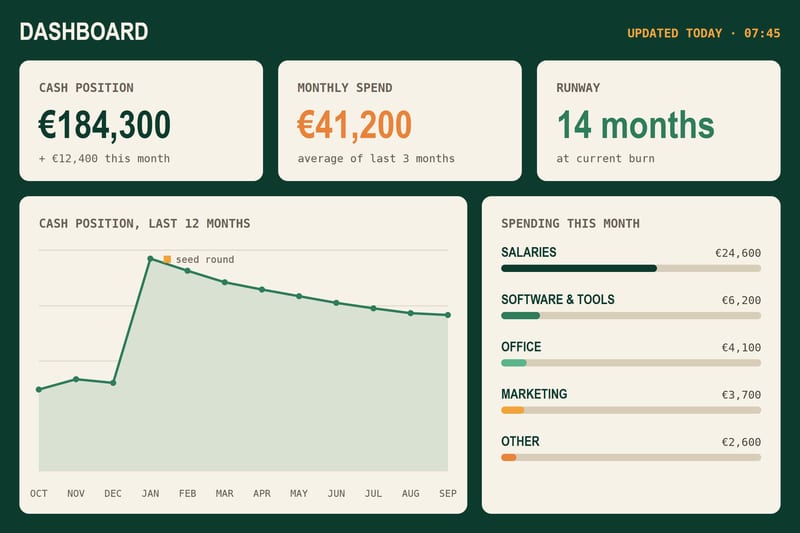
That refund is good for your cash position, and therefore your runway. Make sure your invoices are processed before the return goes in, or the refund will slip by a quarter.
Is the KOR (small business scheme) a good idea for a startup?
Under the KOR (kleineondernemersregeling), you don’t charge VAT or file VAT returns, as long as your revenue stays below €20,000 a year. The catch: you can’t reclaim VAT on your costs either. For a startup spending on software, hardware or contractors, that usually works out expensive. The KOR is mainly suited to businesses with low costs and consumer customers. Talk it through before you sign up.
What about services from abroad?
Software and services from foreign suppliers, such as cloud hosting or advertising, are often invoiced to you without VAT. In that case the VAT is reverse-charged: you report it in your own return and deduct it again as input VAT in the same return. On balance you pay nothing, but the amounts still need to appear in the return. Services from EU countries and from outside the EU go in different boxes.
What if you’ve made a mistake in your return?
Small mistakes of €1,000 or less are corrected in your next return. If the amount is more than €1,000, you submit a correction, known as a suppletie (supplementary return), as soon as possible. You must do this within eight weeks of discovering the mistake.
Which mistakes do we see most often?
- Trying to squeeze invoices dated after the deadline into the previous quarter
- Reclaiming VAT on a pro forma invoice or a quote
- Not reporting services from abroad as reverse-charged VAT
- Claiming input VAT on personal expenses paid from the business account
- Filing the return but forgetting to pay
How do you take the stress out of it?
Filing the return is the easy part; the real work is keeping your books up to date. At Matching Numbers your bookkeeping is updated every day, so your return is ready to go at the end of the quarter. We file it and let you know once it’s done. VAT, payroll tax and corporate income tax (CIT) returns are included in every package; read more about our tax filings.
Sources
- Belastingdienst, Filing and paying your VAT return (in Dutch)
- Belastingdienst, Correcting a VAT return (in Dutch)
- Belastingdienst, Small business scheme (KOR) (in Dutch)
- Belastingdienst, Keeping your records (in Dutch)
— Elaudt