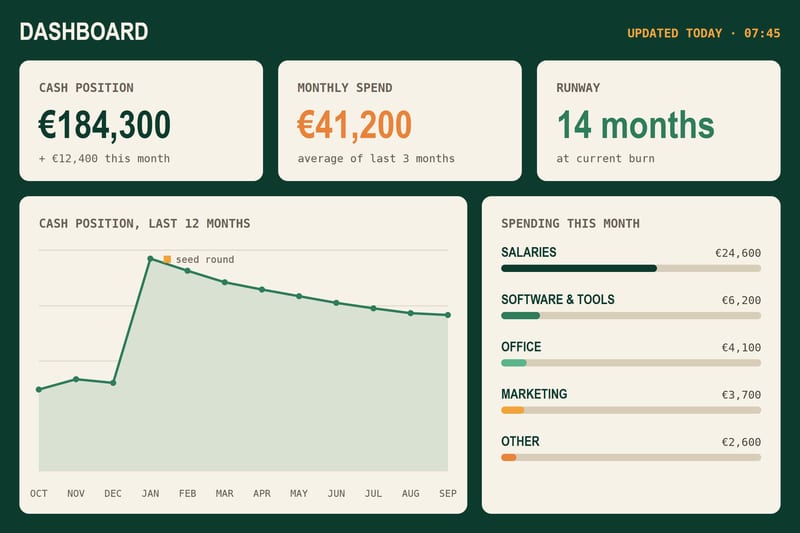
Investors hate surprises. A short monthly report, sent like clockwork, prevents them, and it makes you look at the same numbers every month too. Here’s how to set up a report you can stick to, even when things get busy.
Why report every month?
Often you don’t have to: most investment agreements only ask for a quarterly or annual report. Still, a short monthly update works better. Investors see the trend rather than a snapshot, problems surface sooner, and when your next round comes along you already have a complete set of numbers. It also makes you stop and check your own cash position and runway every month.
What numbers should you include?
- Cash position at the end of the month, and the change since last month
- Burn rate: the net amount going out each month
- Runway: how many months you can keep going at the current rate (see what is runway)
- Revenue or MRR, with month-on-month growth
- Two or three KPIs that matter for your business, such as customers, churn or pipeline
- A short commentary: what went well, what didn’t, and where you need help
More is rarely better. An investor reads ten of these updates a month, so yours should make sense within two minutes.
What does a monthly report look like?
Here’s an example numbers section you can copy:
| September | August | Change | |
|---|---|---|---|
| Cash position | €162,300 | €171,900 | – €9,600 |
| Revenue | €24,800 | €21,300 | + 16% |
| Net burn | €9,600 | €11,200 | – €1,600 |
| Runway | 17 months | 15 months | + 2 months |
| Paying customers | 38 | 33 | + 5 |
Below that come three short sections: highlights (what went well), lowlights (what didn’t, and what you’re doing about it) and asks (how an investor can help, such as an introduction to a customer or a candidate for an open role). That last section is often forgotten, yet it’s exactly why investors read the update.
Why do consistent definitions matter so much?
Most confusion comes from numbers being calculated differently from one month to the next. So agree upfront:
- whether revenue means invoiced or received;
- whether your cash position includes VAT (our advice: no, because you’ll have to pay it over to the tax authorities);
- how you calculate burn: a three-month average or just the last month;
- what exactly counts as an “active customer”.
Then calculate everything the same way every month. The comparison with last month tells you more than the number on its own.
When should you send it?
Pick a fixed day, for example the tenth working day of the month. By then the previous month has been closed, the bank transactions have been processed and the numbers are right. Send it by email, with the numbers in the body and, if you like, a PDF attached. A link to a dashboard that investors have to log in to gets opened less often.
Why pull it straight from your bookkeeping?
A report pieced together from separate spreadsheets takes half a day every month, and sooner or later it will contain a mistake. If it comes straight from up-to-date bookkeeping, it’s ready in fifteen minutes and matches your tax returns and annual accounts. That also saves hassle during due diligence: the numbers your investors received each month tie in with your books.
What mistakes should you avoid?
- Leaving out bad news. Investors would rather see a setback with a plan than a rosy update that later turns out to be wrong. An honest report matters most in a bad month.
- Changing your KPIs every month. It looks as if you’re cherry-picking the numbers that suit you best.
- Skipping a month when you’re busy. A missed month stands out more than a short update.
How do you keep it hassle-free?
At Matching Numbers, your cash, burn and runway are in your dashboard every morning, and every month you get a report you can forward as is. All you write is the commentary. The monthly report is included in every package.
— Boele