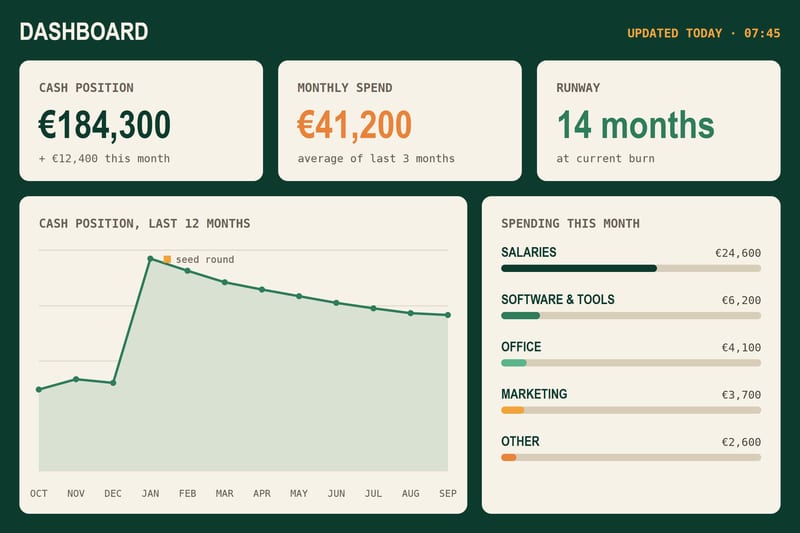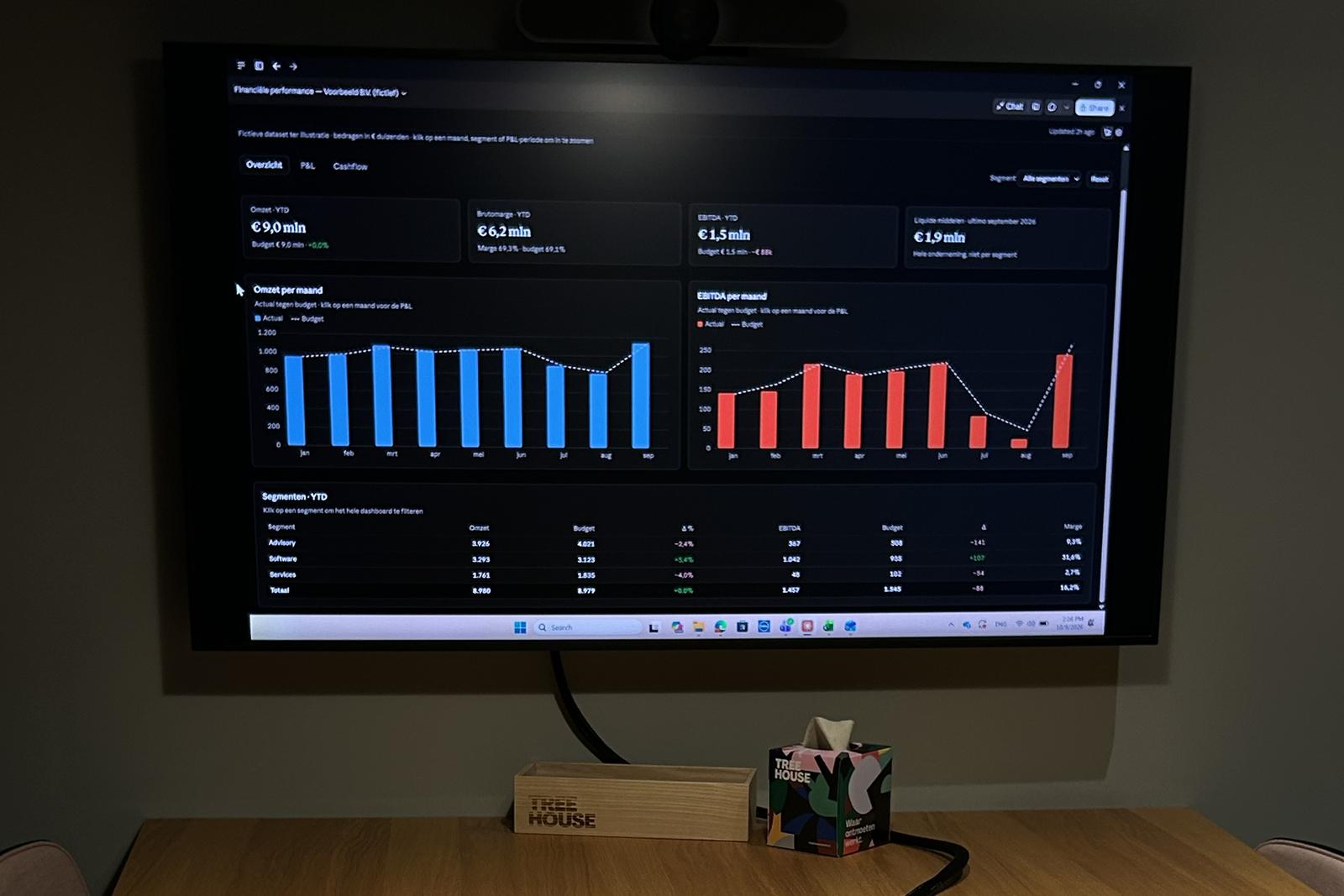
As an investor, you often get your portfolio companies’ numbers once a quarter. By the time you read them, they’re weeks or even months old. For a startup spending tens of thousands of euros a month, that’s a long time. Here’s why quarterly numbers arrive so late, what you miss as a result, and how it can be different.
How old are quarterly numbers when you read them?
Take the third quarter, which runs to 30 September. Many startups only bring their books up to date when the VAT return is due, and in the Netherlands a quarterly return has to be in by the last day of the following month: 31 October for Q3. Then the founder puts the report together. If it reaches you in mid-November, the July figures are almost four months old and the September figures six weeks old.
On average, you’re looking at numbers from about three months ago. You see how things went, not how they’re going.
What can happen in a quarter?
A worked example. A startup has €450,000 in the bank on 1 July and a net burn of €60,000 a month. That’s a runway of 7.5 months.
| 1 July | 30 September | Mid-November | |
|---|---|---|---|
| Cash position | €450,000 | €270,000 | €180,000 |
| Runway | 7.5 months | 4.5 months | 3 months |
Anyone reading the quarterly numbers in mid-November sees a runway of 4.5 months. In reality, only about three months are left at that point. A new funding round can easily take a few months. If you only find out this late, there’s little room left to change course.
And this example assumes a steady burn. If the startup hires three people in August, it moves even faster.
Why do the numbers arrive so late?
- The books lag behind. Many bookkeepers work quarterly, in step with the VAT return. In between, the numbers aren’t up to date.
- The founder builds the report. From a spreadsheet, on top of everything else. It naturally slips down the list.
- Every startup reports differently. Different definitions, different layouts. Before you can compare the numbers, you first have to line them up yourself.
What do you miss as an investor?
- Early signals. Burn creeping up, revenue stalling, customers paying later. With books updated every day, you spot that within a few weeks. In a quarterly report, only months later.
- Moments to help. An introduction to a customer, a conversation about the budget, starting a round in time. The sooner you know, the more you can do.
- A view across your portfolio. With numbers from different dates and in different formats, it’s hard to put your companies side by side.
Is monthly reporting enough?
A monthly report is already a big step forward. But it usually arrives a few weeks after month-end, and the founder has to put it together every time. It can be better still: if the books are updated every day, so is the report.
| Quarterly | Monthly | Updated daily | |
|---|---|---|---|
| Age of the numbers when you read them | 1 to 4 months | 2 to 6 weeks | 1 day |
| Work for the founder | A report every quarter | A report every month | None |
| You spot a setback | Months later | Within a month | The same week |
How do you approach this across your portfolio?
- Agree on a fixed set of numbers. Cash position, burn, runway, revenue or MRR, and two or three KPIs that matter to you. The same for every company, with the same definitions.
- Take the numbers from the books. Not from a spreadsheet the founder keeps on the side. That way they also match the tax returns and the annual accounts.
- Take the work off the founder. A report that comes straight out of the books costs the founder no time, so it keeps coming in busy months too.
- Agree on it when you invest. With each new investment, agree which numbers you’ll receive and how current they’ll be. Sorting it out later is harder.
How does this work at Matching Numbers?
We do the bookkeeping for startups and update it every day. As an investor, you log in to our portal and see the current report for every company connected to us, with all previous reports and your own metrics. With several companies connected, you also get one overview of your whole portfolio. If a startup does its bookkeeping elsewhere, we produce the report every month from the figures we receive. Read more on our page for investors.
Sources
- Belastingdienst, When must my VAT return and payment be received? (in Dutch)
— Boele